



Divorce procedures in Abu Dhabi begin with determining the correct legal path for the case, as the steps may differ depending on the spouses’ religion, the type of marriage, whether children are involved, and the nature of claims related to alimony, custody, or financial rights. In some family law disputes, the matter first goes through family guidance and reconciliation, while civil divorce procedures for non-Muslims follow a different process before the Abu Dhabi Civil Family Court.
An Abu Dhabi lawyer can help you understand the main stages of divorce procedures in Abu Dhabi, from filing the request and attempting amicable settlement to appearing before the competent court. This guide also explains the difference between Sharia divorce and civil divorce, the required documents, and the role of a divorce lawyer in protecting rights and organizing the legal process.
Do You Need to Know the Right Step Before Starting Divorce Procedures?
The legal team at Advocator Abu Dhabi can review your legal situation and explain the most suitable legal path for your case, whether it involves family guidance, the Sharia court, or the Civil Family Court.
Table Of Content
What Are the Divorce Procedures in Abu Dhabi?
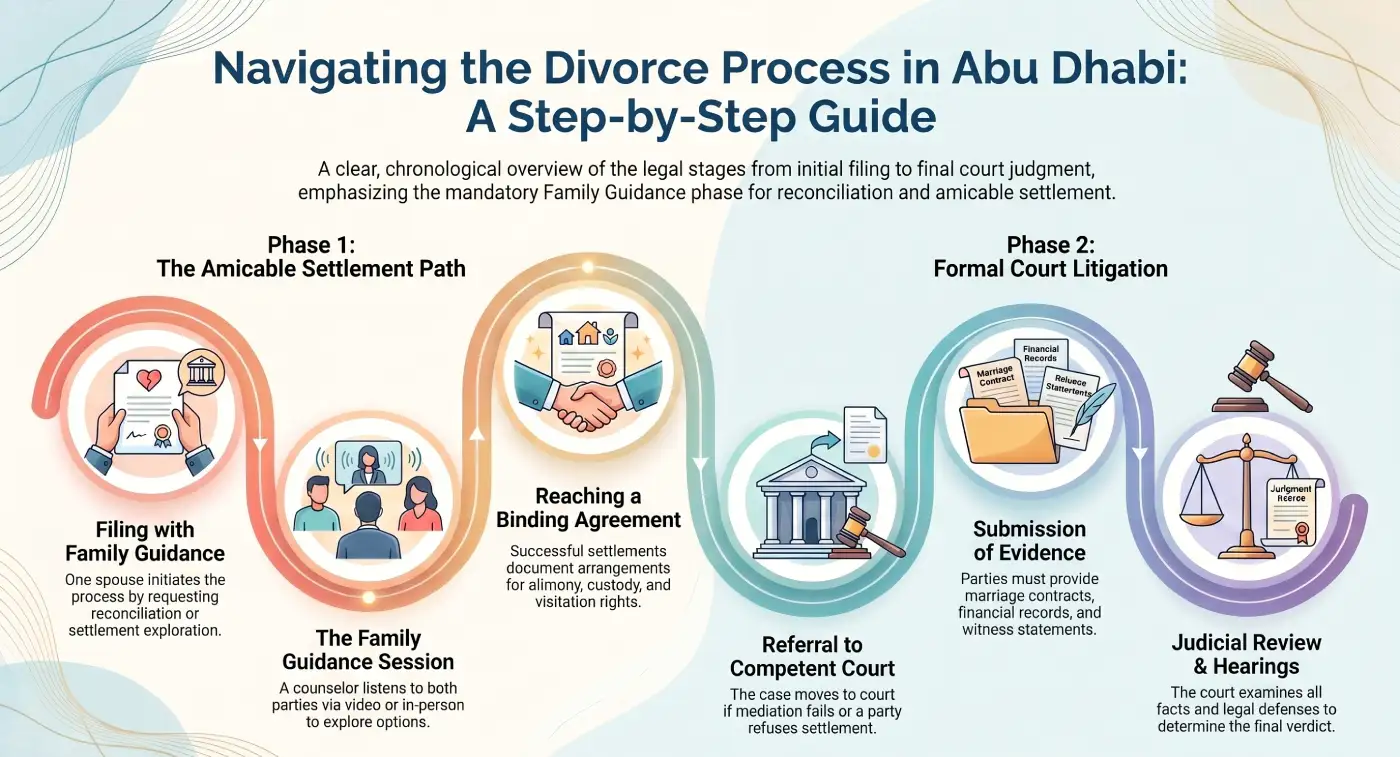
Divorce procedures in Abu Dhabi vary depending on the type of case, but traditional divorce and family law disputes usually follow several organized stages. The process generally starts with an attempt at amicable settlement before moving to court proceedings if no agreement is reached.
Filing a Request with Family Guidance
In many family law cases, one spouse begins by submitting a request to the Family Guidance Department in Abu Dhabi. The purpose of this stage is to encourage reconciliation, discuss the causes of the dispute, and explore amicable solutions before court proceedings begin.
This stage is not limited to discussing divorce itself. It may also involve matters related to alimony, child custody, visitation rights, housing, or other family-related rights that the parties may agree upon.
Scheduling the Family Guidance Session
After the request is registered, a session is scheduled for both parties. Some procedures may be conducted electronically or through video communication depending on the system available at the competent authority.
During the session, the family counselor listens to both parties, seeks to understand the nature of the dispute, and explains the available legal options. In some cases, the parties may reach a settlement that protects their rights and avoids lengthy court proceedings.
Attempting an Amicable Settlement
If the spouses reach an agreement, the settlement may be documented according to the applicable procedures. The settlement may cover divorce arrangements, alimony, custody, visitation rights, or any other financial or family-related matters.
If reconciliation fails or one party refuses to agree, the dispute is referred to the competent court to continue the legal procedures.
Referring the Dispute to Court
When amicable settlement efforts fail, the case file is prepared and legal requests are submitted before the court. At this stage, drafting legal claims and organizing supporting documents become extremely important because the court will examine the facts, evidence, and defenses presented by each party.
Court Hearings and Submission of Evidence
After the case is officially registered, the court begins reviewing the dispute. The court may hear statements from both parties, review documents, and request additional memoranda or defenses if necessary.
Evidence in divorce cases may include:
- The marriage contract.
- Children’s information, if applicable.
- Financial documents.
- Communications related to the dispute.
- Medical or social reports, if available.
- Witness statements or documents supporting claims for alimony, custody, or harm.
What Is the Role of Family Guidance in Divorce Cases?
Family guidance in Abu Dhabi is an important stage because it gives both parties the opportunity to discuss the dispute before it reaches court. Its purpose is not to force the spouses to remain together, but rather to attempt to reach an organized solution that reduces the legal and emotional impact of the dispute, especially when children are involved.
The importance of family guidance includes:
- Helping resolve disputes before filing a court case.
- Providing a calm environment to discuss family-related rights.
- Facilitating settlements related to alimony, custody, or visitation rights where possible.
- Reducing the duration of disputes if a clear settlement is reached.
- Determining whether the dispute can be resolved amicably or requires court intervention.
How to File a Divorce Request Through the Abu Dhabi Judicial Department
Some applications can be submitted through the electronic services available at the Abu Dhabi Judicial Department, subject to the required documents and information depending on the type of case. Generally, the applicant must provide the spouses’ information, marriage details, upload supporting documents, and wait for the appropriate procedure or appointment to be scheduled.
It is important to ensure that all documents are complete before filing, as missing documents may delay the procedure or require additional information to be submitted.
Documents That May Be Required in Divorce Cases
- Official marriage certificate.
- Emirates ID, passport, or residency documents, depending on the parties’ status.
- Children’s birth certificates, if applicable.
- Documents supporting the claims or financial/family requests.
- Proof of income or financial obligations in alimony-related claims.
- Correspondence, reports, or documents related to the dispute where relevant.
Do You Have Divorce Documents and Want to Know If They Are Sufficient?
Mistakes in preparing documents or drafting legal requests may affect the course of your case. Advocator Abu Dhabi can review your file before submission and explain what additional documents or steps may be required.
What Happens If Family Guidance Sessions Fail?
If no amicable solution is reached during family guidance sessions, the case proceeds to the judicial stage before the competent court. At this stage, the matter is no longer a general divorce request; instead, the claims and legal demands must be clearly organized.
The next steps usually include:
- Referral to the competent court: After reconciliation attempts fail, the case proceeds before the court to review the divorce request and related rights.
- Determining the legal type of claim: The nature of the claim must be identified, whether it concerns divorce for harm, khula, divorce confirmation, alimony, custody, housing, or visitation arrangements.
- Preparing the statement of claim and supporting documents: This includes preparing the case file with documents such as the marriage contract, children’s information, financial documents, communications, or any evidence supporting the applicant’s position.
- Serving notice on the other party: The court formally notifies the other party to allow them to attend hearings and submit legal defenses.
- Court hearings: The court hears both parties, reviews documents, and may request additional memoranda or evidence depending on the dispute.
- Possible settlement efforts: Even after the case reaches court, settlement may still be possible regarding issues such as alimony, custody, or visitation rights.
- Issuance of judgment: After reviewing the case, the court issues its judgment regarding the divorce and related rights according to the applicable law and the circumstances of the case.
For this reason, it is important that the case file is properly organized and supported by clear legal requests, because inaccurate drafting or missing documents may delay proceedings or weaken one party’s legal position.
The Difference Between Sharia Divorce and Civil Divorce in Abu Dhabi
It is important to distinguish between Sharia divorce and civil divorce in Abu Dhabi before starting the legal process, because each path differs in terms of the competent court, filing requirements, and how financial rights, custody, and alimony are handled.
| Comparison Point | Sharia Divorce | Civil Divorce |
|---|---|---|
| Applicable Category | Usually applies to Muslims under personal status laws | Applies to non-Muslims under the Abu Dhabi Civil Family Court system |
| Competent Authority | Personal status court | Abu Dhabi Civil Family Court |
| Pre-Court Stage | Usually goes through family guidance first | Does not always follow traditional family guidance procedures |
| Proof of Harm | May be important in some forms of divorce such as divorce for harm | In some cases, proving fault or harm may not be required |
| Nature of Claims | May include divorce, khula, alimony, custody, housing, and visitation rights | May include civil divorce requests, financial settlements, custody, and post-divorce claims |
| Court Approach | Court considers Sharia principles and applicable laws | Court applies civil legal rules and approved procedures |
| Impact on Rights | Rights vary depending on the type of divorce and the presence of children | Financial rights and custody are handled according to the applicable civil system |
In summary, choosing the correct legal path from the beginning can affect the speed of proceedings, the accuracy of legal requests, and the protection of rights. This is especially important if one spouse is non-Muslim, the marriage was registered outside the UAE, or there are financial claims, custody issues, or prior agreements between the spouses.
Types of Divorce Cases In Abu Dhabi Courts
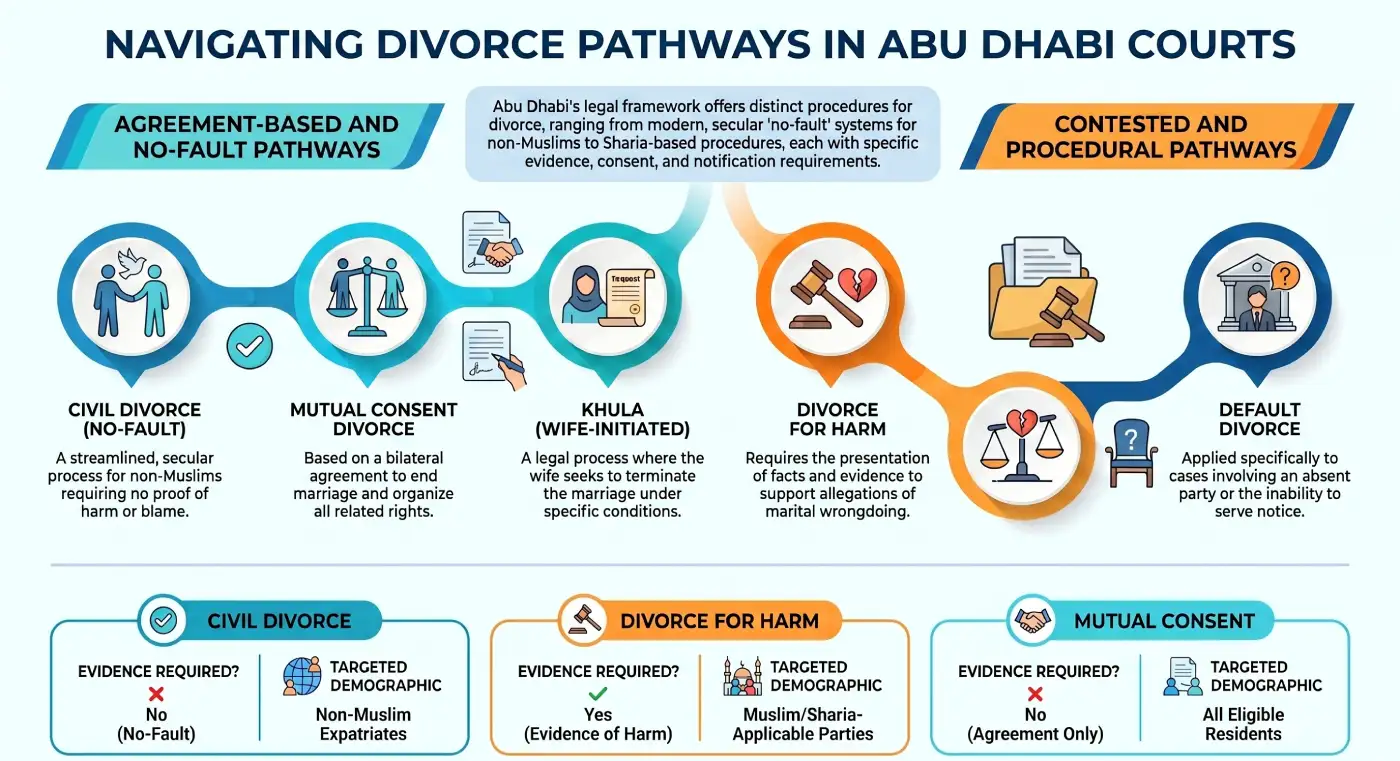
Divorce cases are not limited to one form. Divorce may occur by mutual consent, for harm, through khula, by default due to absence, or through civil divorce for non-Muslims. Each type has different procedural requirements and legal consequences.
- Mutual Consent Divorce: Based on the agreement of both parties to end the marriage and organize related rights.
- Divorce for Harm: Requires presenting facts and evidence supporting allegations of harm.
- Khula: A legal process where the wife seeks to end the marriage according to applicable legal conditions.
- Default Divorce: Related to cases involving absence or inability to notify one party.
- Civil Divorce: Applies to non-Muslims under the Abu Dhabi Civil Family Court system.
Rights of the Wife and Children After Divorce in Abu Dhabi
After divorce, legal issues do not end with the court judgment. Important matters related to alimony, custody, visitation, housing, and financial rights remain. The details of these rights vary depending on the applicable legal system, the nature of the marriage, the presence of children, the financial ability of the parties, and the best interests of the child.
Among the most important issues considered by the court or agreed upon between the parties are:
- Alimony for the wife or divorced wife depending on the legal circumstances.
- Child support, including education and healthcare expenses.
- Custody and visitation or overnight arrangements.
- Custody housing or housing allowance where applicable.
- Dowry, deferred dowry, or financial entitlements related to the marriage contract.
- Financial settlements in civil divorce cases for non-Muslims.
| Issue | What Does It Mean? |
|---|---|
| Wife’s Alimony | Varies depending on the legal status and claims submitted |
| Child Support | Includes essential needs and may include education and healthcare expenses |
| Custody | Considered according to the child’s best interests |
| Visitation or Overnight Access | Regulates contact between the non-custodial parent and the children |
| Custody Housing | May be granted where legal conditions are met |
| Deferred Dowry or Financial Rights | Reviewed according to the marriage contract and legal claims |
| Civil Divorce Financial Settlement | May arise in non-Muslim divorce cases under the civil system |
The Role of a Divorce Lawyer in Abu Dhabi
A divorce lawyer in Abu Dhabi helps organize the case from the very beginning, not only during court hearings. Legal advice becomes especially important when the case involves financial claims, children, civil marriage, a spouse outside the UAE, or documents requiring translation or attestation.
The lawyer’s role usually includes:
- Determining the correct legal path for the case.
- Reviewing the marriage contract and supporting documents.
- Explaining legal options before filing.
- Drafting legal claims and court applications.
- Submitting legal defenses and memoranda before the court.
- Handling issues related to alimony, custody, visitation, and enforcement.
- Attempting settlement solutions that preserve rights where possible.
Having a lawyer does not necessarily escalate the dispute; in many cases, it helps organize procedures and avoid procedural mistakes, especially when the case is sensitive or involves children or foreign documents.
Why Choose Advocator Abu Dhabi for Divorce Cases in Abu Dhabi?
Choosing the right legal representative in divorce cases is not only about filing a lawsuit. It also involves understanding the entire situation, identifying available options, and protecting the client’s privacy during a sensitive period.
Advocator Abu Dhabi is distinguished by:
- Professional and confidential handling of family law cases.
- Careful review of documents and legal claims before recommending action.
- Accurate legal drafting of applications and memoranda.
- Strong understanding of both Sharia and civil divorce procedures in Abu Dhabi.
- Legal support in matters related to alimony, custody, visitation, and financial rights.
- A professional and respectful approach suitable for sensitive family disputes.

When Do You Need Legal Advice Before Starting Divorce Procedures?
You may need early legal advice if you are in one of the following situations:
- You are unsure whether to begin with family guidance or the Civil Family Court.
- The other spouse is outside the UAE or difficult to notify.
- You have children and there are custody, visitation, or alimony claims.
- The marriage was registered outside the UAE.
- There are prior agreements between the spouses.
- You have foreign-language documents requiring translation or attestation.
- You want to understand your legal position before deciding on divorce.
- You are concerned that filing an incomplete request may delay the case.
In such situations, contact us to obtain legal advice that can help reduce mistakes and identify the most appropriate legal path from the beginning.
Frequently Asked Questions About Divorce Procedures in Abu Dhabi
What is the first step in divorce procedures in Abu Dhabi?
Many divorce cases in Abu Dhabi begin by filing a request with Family Guidance to attempt an amicable settlement before moving to court. However, the process may differ if the divorce is a civil divorce for non-Muslims before the Abu Dhabi Civil Family Court.
Is Family Guidance mandatory before filing a divorce case in Abu Dhabi?
In traditional personal status cases, Family Guidance is an important stage before court proceedings. However, in some civil divorce cases for non-Muslims, the procedures may differ depending on the competent authority and the type of request.
When does a divorce case move from Family Guidance to court?
The case moves to court if the spouses do not reach an amicable agreement. After that, the case is registered, and the documents and requests related to divorce, alimony, custody, visitation, or other rights are submitted.
What documents are required to start divorce procedures in Abu Dhabi?
The required documents usually include the marriage certificate, Emirates ID, passport or residence visa, children’s details if applicable, and any documents supporting the request, such as financial documents, correspondence, or relevant reports.
How long does a divorce case take in Abu Dhabi?
There is no fixed duration, as the timeline depends on the type of divorce, whether the documents are complete, the other party’s attendance, whether there is agreement or dispute, and whether there are claims related to alimony, custody, or financial rights.
Can custody and alimony be agreed upon amicably?
Yes, some matters such as alimony, custody, or visitation can be agreed upon amicably. However, the wording should be clear and enforceable, and it is advisable to have it reviewed legally before approval.
What should I do if the other party is outside the UAE?
If the other party is outside the UAE, the case may require special notification procedures and additional documents. In this situation, it is advisable to consult a divorce lawyer in Abu Dhabi before filing the request to determine the most suitable legal path.
Do divorce procedures differ if the marriage was registered outside the UAE?
Yes, the procedures may differ depending on where the marriage was registered, the parties’ nationalities, their religion, and the available documents. Some documents may also need translation or attestation before being used before the competent authorities.
Can a divorce case include alimony and custody claims?
Yes, a divorce case may be linked to other requests such as alimony, custody, visitation, and custody housing. The way these requests are filed may differ depending on the type of case and the competent authority.
Why is it important to review documents before filing a divorce case?
Reviewing the documents helps ensure that the request is complete and clear, reduces the chances of delay or requests for additional information, and helps determine the appropriate legal claims from the beginning.
Start Your Legal Procedures with Clarity
If you are facing a divorce dispute in Abu Dhabi, Advocator Abu Dhabi can review your case and determine the appropriate legal step according to your circumstances, documents, and the applicable law.
Divorce procedures in Abu Dhabi represent a legal process that requires careful understanding from the beginning, because the procedures differ between family guidance, Sharia courts, and the Civil Family Court for non-Muslims. Preparing documents properly, identifying the type of claim, and clearly drafting legal requests are essential factors in reducing delays and protecting legal rights.
Therefore, if you are considering starting divorce proceedings or have received notice of an existing divorce case, obtaining early legal advice can help you understand your legal position and choose the most appropriate course of action.
Legal Disclaimer: The information contained in this article is provided for general educational purposes only and does not constitute specific legal advice. Legal procedures and rights vary depending on each case, so you should consult a licensed lawyer before taking any legal action.
Official Sources
- UAE Legislation Portal — Federal Decree-Law No. 41 of 2022 on Civil Personal Status
- UAE Legislation Portal — Federal Decree-Law No. 41 of 2024 Issuing the Personal Status Law